



Residents Report Ambulance Never Arrived in El Pozón: Oversight Committee Demands Answers from the District

A citizen complaint has once again brought the pre-hospital care system and ambulance service in the District of Cartagena under scrutiny.
The Health Oversight Committee Color Esperanza (Color Esperanza) has asked Mayor Dumek Turbay to urgently review the coverage, availability, distribution, and response capacity of public ambulances, following an incident reported early Saturday morning in the San Nicolás sector of El Pozón.
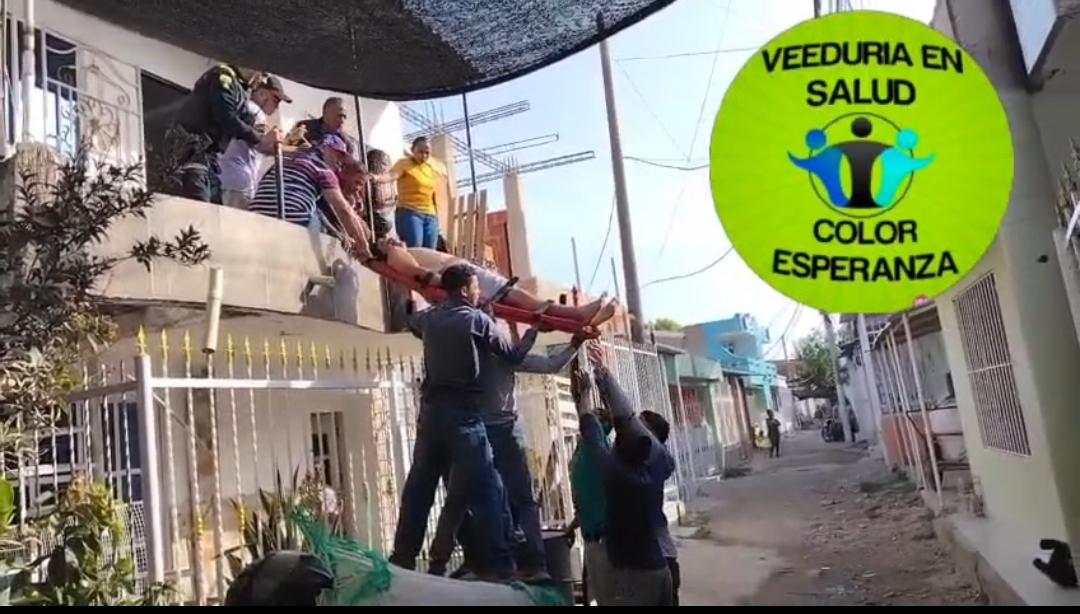
According to information provided by family members and witnesses, a man experienced a medical emergency inside a home. At approximately 5:30 a.m., his family reportedly requested an ambulance.
Units from the National Police and the Fire Department arrived at the scene and remained with the family while they awaited medical attention.
However, according to the complaint, the ambulance never arrived. Faced with the delay, the family had to remove the patient from the home themselves, amidst anguish and uncertainty.
Why didn’t the ambulance arrive?
The oversight committee believes it is necessary to establish what happened from the moment the emergency was reported.
Among the questions raised are:
Who received the emergency call?
What time was it registered?
How was the situation classified?
What ambulances were available?
Who was responsible for dispatching them?
Why, according to the complaint, did an ambulance not arrive at the scene?
What protocol was applied when it was impossible to send a unit?
What was the actual response time?
The organization insists that an ambulance contracted by the District must translate into an effective response capacity when a citizen needs care.
Do medical emergencies receive the same treatment?
One of the aspects the oversight committee is asking to be clarified is the claim that some emergencies might receive a different response when they are not related to traffic accidents.
The organization questions whether there is any difference in prioritization between a patient injured in an accident and a person experiencing a medical emergency in their own home.
“A medical emergency is a medical emergency,” the oversight group maintains, warning that access to care should not depend on the existence of a traffic accident or associated insurance.
They also request clarification regarding alleged guidelines from the Cartagena de Indias Public Health Institution (ESE Cartagena de Indias).
The Color Esperanza Health Oversight Group also requested explanations from the Cartagena de Indias Public Health Institution (ESE Cartagena de Indias) regarding information it claims to have received about alleged guidelines related to the care and transport of homeless individuals.
The organization believes that any protocol of this nature should be publicly explained, especially if it could imply restrictions on care related to a person’s social status.
However, it clarifies that the case reported in El Pozón is different, since, according to family members and witnesses, the patient was inside a home.
Therefore, the central question remains:
Why didn’t the ambulance arrive?
The oversight committee requests access to the call logs, dispatch records, unit availability, and the reasons for the potential lack of response.
Recognition of the Police and Fire Department
The organization also highlighted the presence of units from the National Police and the Fire Department, who arrived at the scene and accompanied the family while awaiting the ambulance.
The oversight committee expressed its gratitude for the actions of these public servants and stated that the purpose of the complaint is not to question the workers who provide their services daily, but rather to demand that the pre-hospital care system function effectively.
The contrast with ambulances responding to traffic accidents
Another point of concern, noted by the oversight committee, is the contrast between the response to traffic accidents and home medical emergencies.
The organization reports that a recent accident involved three ambulances from different companies, although—according to the information received—none were transporting patients at the time.
This incident has led the oversight committee to question whether there is an imbalance in ambulance availability depending on the type of emergency.
The question they pose is clear: Who guarantees a timely pre-hospital response for citizens facing a medical emergency who are not involved in a traffic accident?
Island communities also demand attention
The oversight committee extended its concern to the island communities of Cartagena.
According to the organization, for island residents, a medical emergency can become a race against time, especially when a patient needs to be transferred to Cartagena.
In some cases, families end up resorting to private services and incurring additional costs.
The organization emphasizes that island residents are also residents of Cartagena and demands equal access to healthcare services.
Furthermore, it requests information on the availability and operational status of the water ambulances designated to respond to emergencies in the island communities.
What happens if an ambulance is not available?
The oversight committee believes the District should explain the alternative mechanisms in place when a public ambulance cannot respond immediately.
It also requests a review of response times, the territorial distribution of the units, and the number of ambulances actually operational each day.
Failure to Provide Assistance and Potential Liabilities
The oversight body recalled that Article 131 of Law 599 of 2000, corresponding to the Penal Code, establishes the crime of failure to provide assistance when, without just cause, one fails to help a person whose life or health is in grave danger.
However, the organization clarifies that a delay or failure in service does not automatically constitute a crime.
Any potential criminal, administrative, disciplinary, or civil liability must be established based on the specific circumstances, existing legal and contractual obligations, and the evidence gathered by the competent authorities.
The oversight committee also points out that Article 131-A of the Penal Code, related to the so-called “omission in initial emergency care,” is no longer in effect, as it was declared unconstitutional by the Constitutional Court in Ruling C-302 of 2010.
The oversight committee requests a comprehensive review of the system.
In light of this new complaint, the Color Esperanza Health Oversight Committee requested that Mayor Dumek Turbay and district authorities review:
The number of contracted ambulances.
How many are actually operational.
The distribution of ambulances in Cartagena.
Response times.
The protocols for receiving, triaging, and dispatching patients.
Coverage in island communities.
The availability of water ambulances.
The response mechanisms when a unit is unavailable.
The contractual conditions and service performance indicators. The oversight committee also asked the Cartagena de Indias ESE (Public Health Institution) to clarify the protocols used to handle emergencies and publicly explain the alleged guidelines related to people experiencing homelessness.
The committee also believes that oversight bodies should analyze the reported incidents and determine if any irregularities exist.
“Cartagena needs ambulances that arrive when they are needed.”
According to the organization, the complaint seeks not only to question but also to obtain answers and promote solutions.
The Color Esperanza Health Oversight Committee insists that pre-hospital care must be timely, efficient, and equitable, regardless of the neighborhood, the patient’s social status, the type of emergency, or whether the person lives on the mainland or islands.
The final call is direct: “Cartagena needs ambulances that arrive when they are needed.”
And the citizens, the oversight committee concludes, deserve clear answers about what is failing in the District’s pre-hospital care system.


Debe estar conectado para enviar un comentario.